




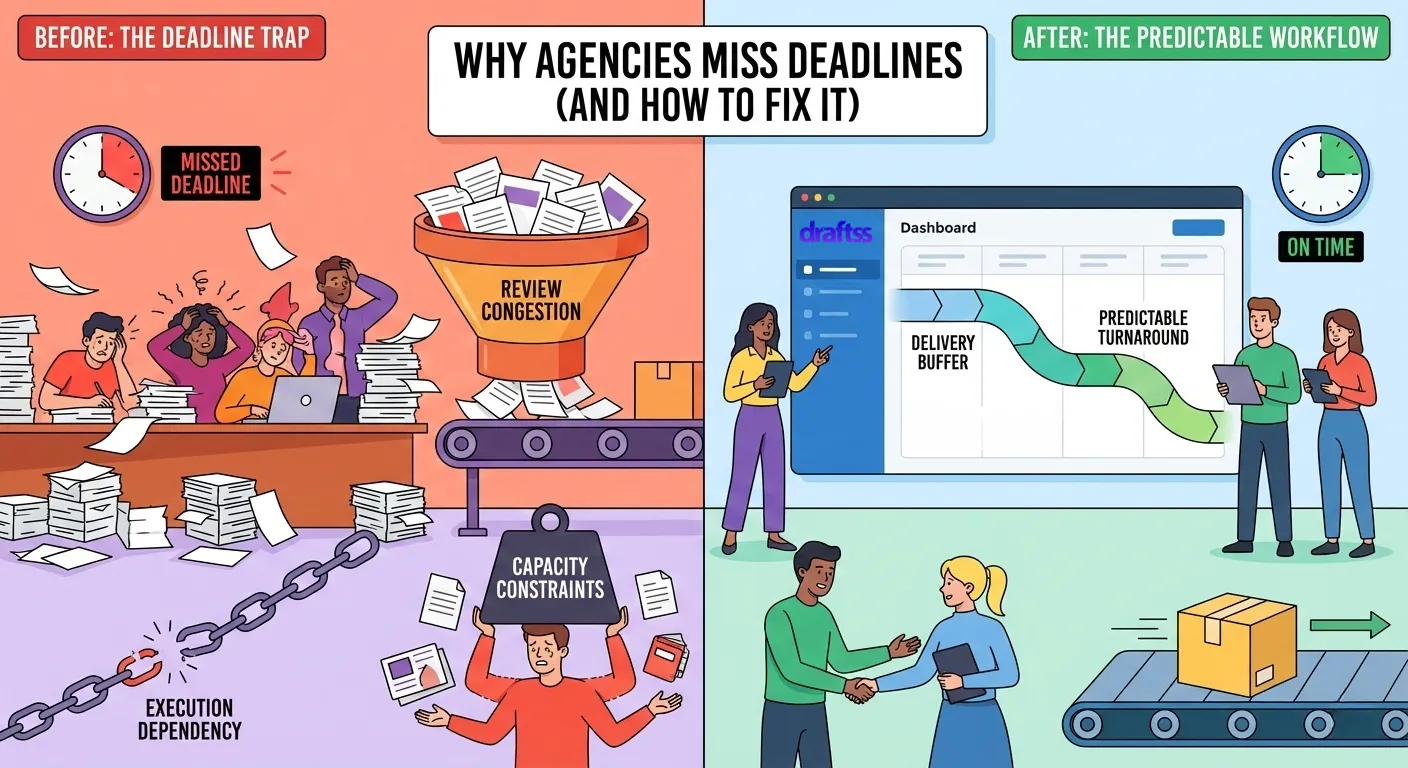
Agencies miss deadlines for reasons that have little to do with poor planning. More often, the real issue is capacity. Teams are stretched thin, reviews pile up, and progress slows as work waits on approvals or handoffs. When execution depends on too many moving parts, even a small delay can ripple through the entire timeline and turn a well planned project into a last minute scramble.
Table of Contents
- Understanding Capacity Constraints in Agencies
- The Impact of Review Congestion on Deadlines
- How Execution Dependency Delays Projects
- Why Even the Best Plans Still Miss the Mark?
- Creating Delivery Buffers
- Predictable Turnaround Times for Better Workflow
- Solutions to Avoiding Deadline Misses
- Frequently Asked Questions
Understanding Capacity Constraints in Agencies
Agencies often face significant capacity constraints that can hinder their ability to meet deadlines. Limited resources such as staff, budget, and technology play a crucial role in this issue. When an agency overcommits to projects, it stretches its resources too thin, resulting in delays that can affect multiple projects simultaneously. Assessing workload before accepting new projects is essential, as this helps avoid the pitfalls of overcommitment and ensures that the team can realistically deliver on time.
Capacity constraints not only impact project timelines but also lead to burnout among team members. When workloads become unmanageable, creativity and productivity suffer, ultimately compromising the quality of work. For instance, an agency that takes on too many clients may find its designers and developers overwhelmed, which can slow down the creative process and delay deliverables.
To better manage available resources, agencies can monitor team workload and allocate tasks effectively. Regular reviews of capacity can help agencies adapt to changing demands, allowing for adjustments in project timelines and resource allocation. For example, an agency that uses a resource management tool can quickly identify when team members are overloaded and redistribute tasks accordingly.
Case studies show that agencies that prioritize capacity planning often achieve more reliable timelines. By streamlining processes and improving efficiency, they can create a more predictable workflow. For instance, an agency that established clear communication protocols and set realistic timelines for feedback found that it could significantly reduce the time spent waiting for client approvals, ultimately enhancing its capacity to deliver on schedule. Agencies need to embrace these strategies to navigate the complexities of capacity constraints and foster a healthier, more productive work environment.
| Capacity Constraint | Impact on Deadlines | Management Strategies |
|---|---|---|
| Limited Resources (Staff, Budget, Technology) | Delays due to overcommitment and burnout | Assess workload before new projects |
| Overcommitting | Stretched resources leading to missed deadlines | Regular reviews of capacity |
| Burnout among team members | Decreased productivity and morale | Streamline processes and improve efficiency |
| Tools for monitoring and allocation | Improper resource allocation causing delays | Utilize software for resource management |
| Case Studies of successful agencies | Illustrate effective management of constraints | Learn from successful implementations |
The Impact of Review Congestion on Deadlines
Review congestion occurs when multiple reviews pile up, leading to delays in project timelines. This often stems from the sheer number of stakeholders involved and the varying priorities they bring to the table. When feedback loops drag on longer than expected, agencies find themselves scrambling to meet deadlines, which can result in compromised work quality or missed opportunities. Communication plays a vital role here; without clear dialogue among stakeholders, misunderstandings can exacerbate delays.
To streamline the review process, agencies can implement strict timelines for feedback, ensuring that everyone is on the same page. Technology also offers solutions, such as collaborative tools that allow for real-time comments and edits, which can significantly speed up the review cycle. Prioritizing feedback is crucial, too; agencies should establish a system for ranking input based on its importance and relevance to the project.
Parallel reviews can also be a game-changer, allowing different stakeholders to provide feedback simultaneously instead of sequentially. Setting expectations with clients about review times fosters a smoother workflow and reduces anxiety on both sides. There are success stories of agencies that have effectively tackled review congestion, resulting in faster turnaround times and happier clients. By recognizing and addressing these bottlenecks, agencies can reclaim valuable time and enhance their efficiency.
- Define review congestion and its effects on project timelines.
- Explore the reasons why reviews often take longer than expected.
- Discuss how multiple stakeholders can complicate the review process.
- Highlight the importance of clear communication during reviews.
- Suggest ways to simplify the review process, such as setting strict timelines.
- Examine the role of technology in facilitating faster reviews.
- Provide tips for agencies to prioritize feedback effectively.
- Discuss the potential for parallel reviews to speed up the process.
- Encourage agencies to set expectations with clients about review times.
- Share success stories of agencies that reduced review congestion.
How Execution Dependency Delays Projects
Execution dependency refers to the reliance of one task on the completion of another within a project management framework. When a single task stalls, it can create a domino effect, halting progress on the entire project. For example, if a design team needs feedback on a draft before they can move forward, any delay in that feedback pushes back the entire timeline, affecting not just that team but everyone downstream. Identifying these dependencies early in the planning phase is vital, as it allows teams to anticipate potential bottlenecks and develop strategies to mitigate them.
To manage dependencies effectively, teams can create a detailed project roadmap that highlights critical paths and interdependencies. Clear roles and responsibilities are crucial in this context; when everyone knows their part in the process, it reduces the chances of tasks being overlooked or delayed. Agile methodologies excel at handling dependencies, as they emphasize iterative progress and regular check-ins, allowing teams to adapt quickly when an issue arises.
Tools like Gantt charts and project management software can help visualize dependencies, making it easier to track progress and adjust timelines as needed.
Moreover, fostering cross-team collaboration is essential for addressing dependencies quickly; when teams communicate openly about challenges, they can work together to find solutions. For instance, a case study from a marketing agency showed that improved collaboration among design and content teams significantly reduced delays caused by execution dependency. Proactive planning, therefore, is not just a good practice; it’s a necessity for minimizing execution dependencies and ensuring timely project delivery.
Why Even the Best Plans Still Miss the Mark?
When it comes to planning, many agencies stumble over common pitfalls that lead to those dreaded missed deadlines. One major issue is setting unrealistic timelines, which can create a perfect storm for failure. Teams often feel pressured to deliver quicker than they realistically can, resulting in burnout and subpar work.
Flexibility is key; a rigid plan can crumble under pressure, while a flexible approach allows teams to adapt to unexpected changes. Stakeholder input is another crucial factor. Without it, plans can lack the necessary detail, leaving teams confused and unsure of their direction. Breaking projects down into smaller, manageable tasks can also make a significant difference. For example, a successful agency might divide a large campaign into phases, allowing for focused efforts and easier monitoring of progress.
Regular check-ins help ensure that plans remain viable and any needed adjustments can be made on the fly. Utilizing the right tools can enhance planning effectiveness too, streamlining communication and task management. Lastly, learning from past experiences with missed deadlines can provide invaluable insights, helping agencies refine their planning strategies for the future.
Creating Delivery Buffers
Delivery buffers can play an important role in helping agencies manage timelines more effectively. One way agencies create these buffers is by reducing execution bottlenecks at the production level. When design or development work queues up internally, timelines shrink and buffers disappear. Using white-label design support allows agencies to protect delivery timelines without forcing teams to rush or overextend themselves.
Including extra time in a timeline can lead to more thoughtful workflows. Teams have space to review work, incorporate feedback, and address revisions without rushing. For instance, feedback sessions do not need to be compressed into tight windows, which can improve clarity and collaboration. Agencies can make better use of delivery buffers by reviewing past projects, identifying recurring bottlenecks, and allocating time where delays are most likely to occur.
Clear communication with clients is also essential. Explaining why buffers exist helps set realistic expectations and reinforces a focus on quality rather than speed alone. Sharing examples of how buffered timelines have helped avoid last-minute issues can further support this understanding.
Buffers are particularly useful when projects change direction late in the process. With additional time built in, teams can respond to new requests without compromising the overall outcome. Over time, this approach encourages steadier workflows, more consistent delivery, and a more sustainable pace of work.
Predictable Turnaround Times for Better Workflow
Predictable turnaround times refer to the ability of an agency to consistently deliver work within a set timeframe, creating a reliable schedule for both clients and team members. This consistency matters because it builds trust with clients, who feel more secure knowing when to expect results. When clients can rely on agencies to meet deadlines, it enhances their overall satisfaction and strengthens the relationship. Moreover, predictable timelines can significantly boost team morale. When team members know what to expect, they can manage their workload more effectively, leading to a healthier work environment.
To establish consistent turnaround times, agencies can start by analyzing past projects to identify average completion times. Using this data, agencies can create realistic timelines that account for potential hiccups. Communicating these established turnaround times clearly to both clients and team members is crucial, ensuring everyone is on the same page. Additionally, leveraging technology, such as a project management tool, can aid in tracking progress and improving turnaround times by providing real-time updates and insights.
Agencies that have successfully implemented predictable turnaround times often report increased efficiency. For example, a design agency that established a standard two-week timeline for project completion saw a significant reduction in last-minute rushes and stress levels among staff. It’s important for agencies to regularly review and adjust these turnaround times based on current capacity and workload. When turnaround times are predictable, everyone benefits: clients receive timely results, and teams can work without the pressure of uncertainty.
Solutions to Avoiding Deadline Misses
To prevent missed deadlines, agencies can adopt several key strategies. First, setting clear and achievable goals is essential. When everyone knows what is expected, it reduces confusion and keeps the team aligned. Regular progress tracking and reporting are also crucial, as they provide insight into how the project is advancing and highlight any potential delays early on.
Team collaboration plays a significant role in meeting deadlines. Encouraging open communication allows team members to share challenges and brainstorm solutions. Prioritizing tasks effectively can prevent bottlenecks; using methods like the Eisenhower Matrix can help identify which tasks are urgent and important.
Moreover, contingency planning is vital. By anticipating possible setbacks and having a plan in place, teams can adapt quickly without derailing the entire project. Agencies should also educate clients about the timeline, making sure they understand the process and factors that can affect deadlines.
Utilizing tools and software designed for project management, such as Trello or Asana, can keep everyone on track and accountable. Success stories of agencies that have implemented these solutions show that with the right strategies, meeting deadlines is not just a goal, but a reality.
Frequently Asked Questions
Why do agencies often miss deadlines if it’s not about planning?
Agencies may struggle with communication issues, unexpected challenges, or resource constraints that catch them off guard, even if they have a solid plan in place.
How can communication affect an agency’s ability to meet deadlines?
When team members or clients don’t share updates regularly, misunderstandings can arise, leading to delays in project completion.
What unexpected challenges can agencies face that lead to missed deadlines?
Agencies might encounter sudden shifts in client needs, tech problems, or even staff changes that can throw off their timeline.
How do resource constraints play a role in agencies missing deadlines?
Limited staff or budget can hinder an agency’s ability to deliver on time, even when they are well-intentioned and organized.
What can agencies do to improve their chance of meeting deadlines despite these challenges?
Agencies can enhance communication, stay flexible to changes, and ensure they have adequate resources to adapt quickly to unforeseen issues.
TL;DR Agencies rarely miss deadlines because of bad planning. They miss them because execution systems break under pressure.
Capacity overload, review congestion, and task dependencies create bottlenecks that even the best project plan cannot survive. When teams are stretched thin and work queues up, small delays cascade into major timeline failures.
The solution is not tighter schedules. It is building operational capacity into the delivery process. Agencies that use white-label production support can create delivery buffers, reduce internal bottlenecks, and maintain predictable turnaround times without overloading their teams.
When execution capacity becomes flexible, deadlines stop being recovery missions and become part of a stable workflow.
Drop your thoughts in the comments below.
Your email address will not be published. Required fields are marked *