



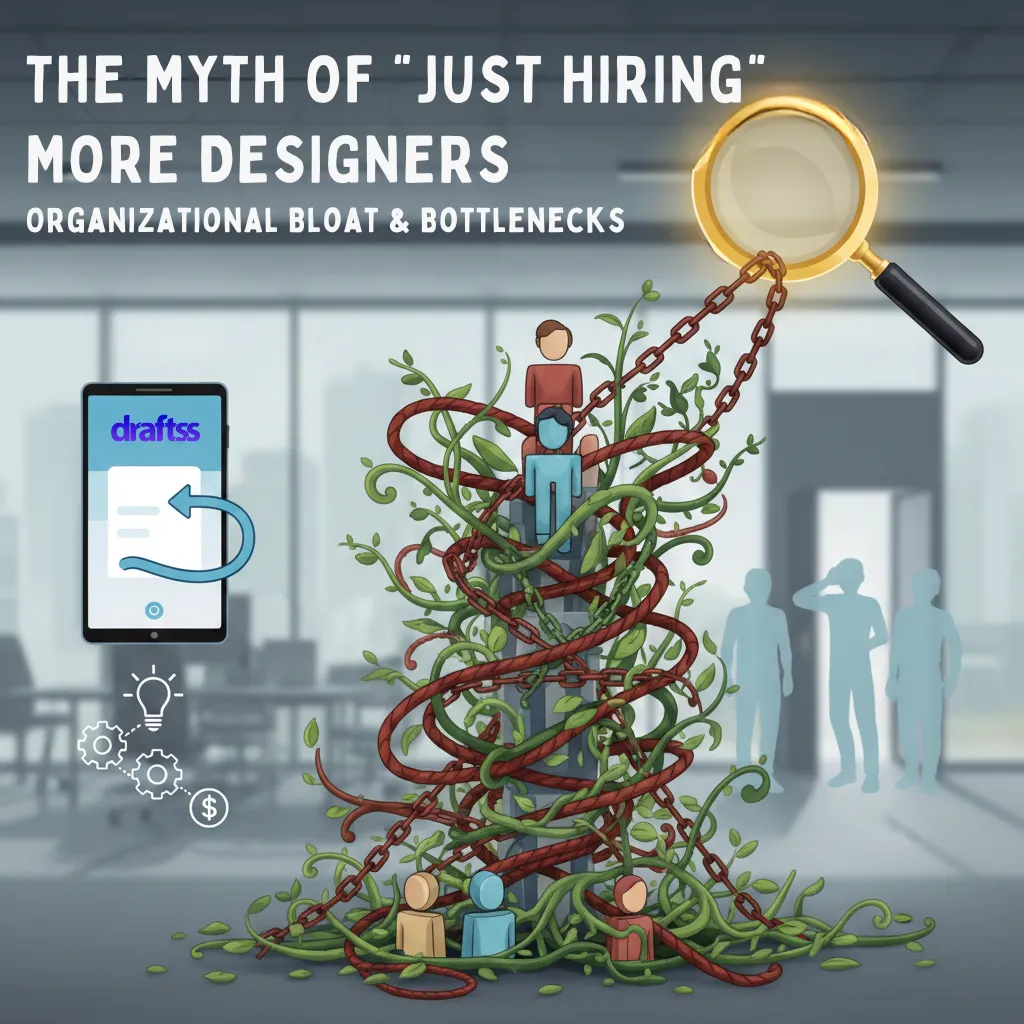
Relying solely on hiring more designers to solve productivity issues can lead to misguided outcomes. When companies rush to expand their teams, they often face organizational bloat and increased management overhead. This extra complexity can slow decision-making and impair communication, which ultimately hampers agility. Additionally, onboarding new hires isn’t just time-consuming; it comes with significant costs that can diminish early productivity due to poor integration processes. The emotional toll of constant context-switching further drains creativity in design roles. Instead of traditional hiring approaches, organizations should consider flexible solutions like Draftss that offer scalable design resources without the added complications and expenses of full-time staff.
Table of Contents
- Debunking Hiring as a Default Solution
- Understanding Hiring Delays and Onboarding Costs
- The Hidden Costs of Context-Switching
- Management Overhead and Its Impact
- Why More Headcount Can Mean More Chaos
- Positioning Draftss as Elastic Capacity
- Flexible Talent Solutions for Design Needs
- Outcome-Oriented Work with Draftss
- Frequently Asked Questions
Debunking Hiring as a Default Solution
Hiring more designers might sound like an easy fix to productivity issues, but it often backfires. Overhiring can lead to organizational bloat, making teams feel heavier and less efficient. When companies grow too quickly, they risk diluting their culture, which can hurt morale and create confusion among employees. More hires often mean more management layers, which can slow down decision-making and bog down the creative process. Communication becomes trickier as teams expand, leading to breakdowns that hamper collaboration. Instead of a smooth operation, rapid scaling may create chaos.
It’s crucial to remember that hiring should be strategic, not just a knee-jerk reaction. Quality trumps quantity when it comes to maintaining productivity. A lean, cohesive team can often outperform a larger group that lacks focus and direction. Plus, overhiring increases operational costs, putting additional strain on budgets. Companies should explore other solutions, like optimizing existing workflows or investing in tools that enhance efficiency, before defaulting to hiring more staff.
- Overhiring often leads to organizational bloat and inefficiencies.
- Increased headcount can dilute company culture, impacting morale.
- More employees mean more management layers, slowing decision-making.
- Communication breakdowns become common with larger teams.
- Rapid scaling can lead to chaos rather than improved output.
- Hiring should be strategic, not a knee-jerk reaction.
- Quality over quantity is essential for maintaining productivity.
- Overhiring can result in increased operational costs.
- A lean team can often outperform a larger, less cohesive group.
- Companies should explore alternative solutions before increasing headcount.
Understanding Hiring Delays and Onboarding Costs
Bringing new designers on board isn’t just about filling seats; it’s a complex dance that involves significant costs and time. The average onboarding cost can hit around $7,500 per new hire, which includes everything from training sessions to the resources needed to get them up to speed. But there’s more to it than just the dollar signs. When onboarding is poorly executed, companies can experience a staggering 20% drop in productivity during the initial months. Imagine the frustration of having new talent who aren’t hitting their stride while deadlines loom and projects fall behind.
Moreover, the time spent on onboarding can detract from the productivity of the existing team, as they often have to divert their focus to assist new hires. This can create a bottleneck, delaying project timelines and impacting overall team morale. New hires typically take longer to reach full productivity compared to seasoned team members, leading to a ripple effect of dissatisfaction, not just for the new employees but also for the entire team.
Investing in a robust onboarding process is crucial for retention, as it sets the foundation for an employee’s experience within the company. A streamlined onboarding process can enhance team efficiency, allowing everyone to focus on their core tasks rather than getting bogged down in the intricacies of training. In the fast-paced world of design, where creativity thrives on collaboration and momentum, having a well-oiled onboarding machine can make all the difference.
| Aspect | Details |
|---|---|
| Average Onboarding Cost | $7,500 per new hire |
| Productivity Loss from Poor Onboarding | 20% in initial months |
| Time Investment in Onboarding | Time spent on onboarding detracts from team productivity |
| Importance of Effective Onboarding | Crucial for employee retention |
| Training Resources Required | Adds to onboarding costs |
| Impact of Hiring Delays | Can lead to missed project deadlines |
| Effect of Inadequate Onboarding | Fosters early employee dissatisfaction |
| Time to Full Productivity | New hires take longer compared to established team members |
| Investment Benefits in Onboarding | Significantly reduces turnover rates |
| Streamlined Processes | Enhances overall team efficiency |
The Hidden Costs of Context-Switching
Context-switching is a silent productivity killer that affects many design teams. Studies show that it can slash productivity by up to 80%, making it a significant barrier to achieving quality work. In design roles, where deep focus is essential for creativity, frequent changes in tasks disrupt the flow of ideas and problem-solving. This constant switching not only stifles creativity but also leads to mental fatigue, as employees struggle to maintain concentration amidst the chaos.
Moreover, the emotional toll is considerable. Employees who face frequent interruptions often experience heightened stress levels, which can spiral into burnout if not addressed. This kind of environment reduces job satisfaction, as creative professionals find it challenging to engage meaningfully with their work. On the flip side, minimizing interruptions and fostering a focused work environment can lead to improved work quality and higher morale.
Implementing effective time management strategies can help mitigate the costs associated with context-switching. For instance, design teams can benefit from dedicated blocks of time for specific tasks, allowing them to dive deep into their projects without the constant pull of shifting priorities. Additionally, using task management tools can streamline workflows, making it easier to keep track of progress without the need for constant mental resets. In this way, fostering an environment that values focus can greatly enhance creativity and efficiency in design work.
Management Overhead and Its Impact
Increasing headcount can seem like a solution to design challenges, but it often introduces a host of management complexities. Each new designer adds layers to the management structure, complicating communication and decision-making. This can lead to longer approval cycles, which stifle the innovation that fresh talent is meant to drive. Instead of fostering creativity, more employees can result in more meetings, pulling everyone away from productive work. As teams grow, the risk of diluting company culture becomes real, potentially eroding the values and dynamics that made the organization thrive in the first place.
Moreover, increased complexity can breed confusion and miscommunication. When roles are not well-defined, team members may find themselves overlapping in responsibilities, leading to frustration and inefficiency. Organizations must strike a balance between growth and effective management strategies. By establishing clear, well-defined roles, companies can help mitigate the burden of management overhead. Streamlined processes enhance decision-making efficiency, allowing teams to focus on what truly matters: delivering outstanding design work.
Investing in management training can also improve team cohesion, enabling managers to guide their teams effectively amid growth. Regular assessments can identify unnecessary management layers, helping to simplify the structure and maintain agility. In this way, organizations can grow without getting bogged down in the complexities that often accompany increased headcount.
Why More Headcount Can Mean More Chaos
Bringing more designers into a team might sound like a quick fix for productivity, but it often leads to confusion rather than clarity. When headcount increases, roles and responsibilities can become blurred, making it hard for team members to know who is accountable for what. This lack of clarity can breed chaos, especially if communication channels are not strong. With more people involved, information can get lost or misinterpreted, leading to frustration and inefficiencies.
Instead of fostering collaboration, a larger team can sometimes spark competition among designers, as they vie for recognition and approval. This competitive atmosphere can hinder teamwork, which is essential for creative processes. Moreover, project management becomes more complicated with numerous contributors, as coordinating efforts and timelines can feel like herding cats.
Rapid scaling can also misalign team goals, creating a situation where everyone is working hard, but not necessarily towards the same objectives. Overstaffing can lead to overlapping tasks, where multiple designers might be doing similar work without realizing it. This redundancy wastes resources and time, further complicating workflows.
Frequent changes to team composition can disrupt established rhythms and processes, making it harder for employees to find their footing. This chaotic environment can sap morale, resulting in stress and burnout. Therefore, it is crucial for companies to balance headcount with effective workflows. Focusing on efficiency, rather than just increasing numbers, is key to creating a productive and harmonious design team.
Design Capacity That Expands and Contracts With Reality
Hiring more designers often sounds like the obvious solution when work piles up. In practice, it rarely maps cleanly to how design demand actually behaves. Workloads spike before launches, slow down after releases, and fluctuate in ways that don’t justify permanent headcount changes.
This is where an elastic approach to design capacity becomes useful. Instead of tying output to fixed roles, teams can scale design effort up or down based on what is actually happening. During high-pressure moments, like product launches or campaigns, extra capacity absorbs the surge. When things quiet down, there is no excess weight to carry.
The benefit is not just cost control; it is operational clarity. You are not managing utilization, backlogs, or idle time. You are simply matching design effort to real needs. That shift, from staffing for possibility to resourcing for reality, makes teams more responsive without adding management complexity.
An elastic model also reduces friction during tight timelines. There is no long onboarding cycle or internal reshuffling. Design support can step in, execute, and step back once the work is done. The result is faster turnaround without sacrificing consistency or quality.
Rather than replacing in-house teams, elastic capacity works alongside them, absorbing variability so internal designers can stay focused on the work that benefits most from deep context and continuity.
Flexible Talent Solutions for Design Needs
Flexible talent models are revolutionizing how companies approach design needs. By utilizing external resources, organizations can adapt quickly to changing demands, ensuring they stay ahead in a fast-paced market. This flexibility allows for optimized project delivery timelines, enabling teams to launch products and features more efficiently.
A diverse talent pool brings fresh perspectives to design challenges, fostering creativity and innovation. When companies tap into specialized skills on demand, they enhance their project capabilities without the burden of permanent commitments. This not only maintains high-quality output but also reduces the risks associated with overhiring, which can lead to cultural dilution and communication breakdowns.
Moreover, flexible solutions can significantly improve overall team morale. Employees are more likely to enjoy a balanced work-life when they can collaborate with freelancers and external experts, creating a dynamic and engaging workplace. Draftss, for instance, can seamlessly integrate into existing workflows, providing the design capacity needed without complicating management structures. This model allows companies to experiment with different design approaches without long-term obligations, making it easier to pivot and innovate.
A Clearer Way to Evaluate Design Work
Focusing on outcomes changes how design work gets evaluated and executed. Instead of tracking effort through hours or activity, the emphasis shifts to whether the work actually solves the problem it was meant to address. This makes priorities clearer for everyone involved and reduces the noise that often surrounds creative projects.
When deliverables are tied to defined goals, progress becomes easier to assess. Teams know what success looks like, and decisions can be made faster without getting stuck in process. Work moves forward based on impact, not time spent, which helps avoid unnecessary delays and overproduction.
An outcome-oriented approach also changes how feedback is used. Rather than iterating endlessly, feedback is anchored to whether the work supports the intended result. This makes it easier to adjust direction when requirements shift, while still keeping momentum intact.
Over time, working this way builds a more collaborative dynamic. Expectations are shared, accountability is clearer, and improvements happen naturally as patterns emerge. Design becomes less about maintaining output and more about supporting real business needs as they evolve.
Frequently Asked Questions
Why is just hiring more designers not the best solution?
Simply bringing more designers on board doesn’t automatically improve the quality of work or speed up the design process. It can actually lead to confusion and miscommunication among team members.
What are some common mistakes teams make when hiring multiple designers?
Teams often think that adding more designers will solve their problems, but it can actually create bottlenecks, as too many opinions can clash, making decision-making harder.
How can a small team achieve great design results?
A small, focused team can be more effective by encouraging clear communication and collaboration, making sure everyone is on the same page to streamline the design process.
What should teams focus on instead of just hiring more designers?
Teams should look into improving their processes, investing in good tools, and offering training for existing designers to boost their skills and efficiency.
How does effective collaboration benefit design projects?
When designers collaborate effectively, it leads to innovative ideas, reduced errors, and a more unified vision that can elevate the overall quality of the project.
TL;DR Hiring more designers feels like the obvious fix when workloads increase, but it often creates new bottlenecks instead of solving old ones.
More headcount brings onboarding delays, higher management overhead, context-switching, and communication complexity. As teams grow, coordination slows, focus drops, and creative output does not scale in proportion to cost. The result is heavier structure, not higher productivity.
Design demand rarely behaves in a straight line. Work spikes during launches and compresses between cycles, which makes permanent hiring a poor match for real workload patterns. Teams need capacity that adjusts to demand, not fixed payroll tied to fluctuating output.
Elastic design support, like Draftss, allows companies to expand and contract execution capacity without adding organizational weight. Internal designers stay focused on high-context work, while overflow and variability are absorbed externally.
When design capacity becomes flexible instead of fixed, teams move faster, management stays simpler, and productivity improves without growing headcount.
Drop your thoughts in the comments below.
Your email address will not be published. Required fields are marked *