




Key takeaways
- Brand licensing lets you borrow a bigger brand’s attention. The trade-off is that you need clear rules about what’s yours and what’s theirs.
- Consumers respond well to collabs that feel natural. 51% say fit is what makes them work, according to MX8 Labs.
- You don’t need a license to join a cultural moment. You do need to avoid using someone else’s characters, logos or marks.
- Consistency still pays. Lucidpress reported in 2019 that consistent branding can lift revenue by up to 33%.
This week, “Dead by Daylight” is one of the most searched terms in the US. The reason: a crossover with Terrifier, the horror franchise behind Art the Clown. The public test build opened on October 27, 2026, and the full chapter was announced for November.
Here’s what’s interesting from a branding standpoint. Behaviour Interactive makes the game. The Terrifier logo and character belong to Damien Leone’s franchise. Two brands, two identities, one product. And it works because each side keeps its identity while borrowing the other’s audience.
That’s brand licensing in action. And whether you’re a ten-person startup or a growing SaaS team, there’s a version of it you can use, if you do it carefully.
What brand licensing actually is?
Brand licensing means you get permission to use another company’s name, characters, logo or other intellectual property, usually in exchange for a fee, a revenue share or a mutual benefit. The owner sets rules. You follow them.
It’s different from three things that often get confused with it:
- Co-branding: two brands appear together on a joint product or campaign, each keeping its own identity.
- Sponsorship: you pay to be associated with an event or property.
- Trend-jacking: you reference a cultural moment without using anyone’s protected assets.
| Approach | Needs permission? | Cost/effort | Risk | Best for |
|---|---|---|---|---|
| Brand Licensing | Yes, formal agreement | High | Medium (contract terms, approvals) | Product collabs with large IP |
| Co-branding | Yes, mutual agreement | Medium | Medium (brand mismatch) | Joint launches, webinars, bundles |
| Sponsorship | Yes, paid | Medium to high | Low to medium | Events, communities, creators |
| Trend-jacking | No, if you avoid protected assets | Low | Medium (tone, legal edge cases) | Social content and timely campaigns |
I’m not a lawyer, and nothing here is legal advice. If you’re signing anything or using a third party’s marks, talk to an attorney.
Why collabs work: the data
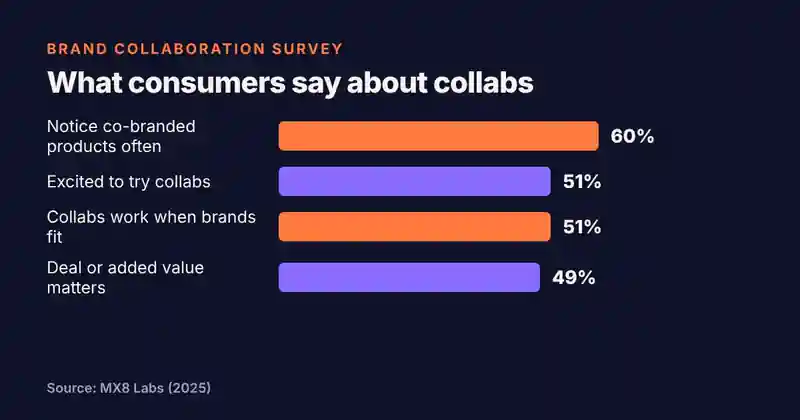
MX8 Labs’ brand collaboration research, published in December 2025 and updated in May 2026, offers a snapshot of consumer attitudes. (The page doesn’t state the sample size or survey dates, so treat it as directional.)
| Finding | Figure |
|---|---|
| Notice special-edition or co-branded products “often” or “always” | Nearly 60% |
| Excited to try brand collaborations | 51% |
| Have bought a co-branded or special-edition product | 68% |
| Say collabs work when brands fit naturally | 51% |
| Say a deal or added value makes a collab appealing | 49% |
| Say collabs make brands feel more current and culturally in tune | 51% |
| Say partnerships with movies, shows or teams increase interest in that content | 57% (77% for Millennials) |
Source: MX8 Labs
An older survey, from Visual Objects in 2021 (501 Americans, reported by YouGov), found 71% prefer it when multiple businesses collaborate to offer a unique product, and 43% are willing to try new co-branded products from brands they already enjoy. Small sample, a few years old, but pointing the same way.
The takeaway: fit matters more than fame. Half of consumers say a natural match is what makes a collab work. For a gaming-world look at brands fighting for attention, see our post on standing out in a crowded release week. A horror game and a horror film franchise is an obvious match. A project management tool and a pizza chain, not so much.
The identity problem: what to keep and what to share
Here’s where startups get burned. They get excited about a partnership, mash two brands together, and end up with something that looks like neither.
The fix is to decide, before any design work starts, what stays fixed and what flexes. If your brand visual identity isn’t documented yet, start there.
Keep fixed (your brand’s non-negotiables)
- Logo, clear space and minimum size
- Primary typeface and type hierarchy
- Core color palette
- Voice and tone principles
- Product naming conventions
Allow to flex (the collab layer)
- An accent color or illustration style
- Co-branded lockup (logo + partner logo, with agreed spacing)
- Imagery and campaign-specific copy
- Temporary badges, stickers or backgrounds
Lucidpress’s State of Brand Consistency report (2019, 200+ organizations) found that consistent branding can raise revenue by up to 33%, and that 81% of companies still deal with off-brand content. That’s an older, vendor-run study from a brand templating company, so don’t treat the exact number as gospel. But the point stands: the more partners and channels you add, the more you need guardrails. Our guide to cohesive branding strategies and techniques covers how to build them.
Borrowing a moment without a license
Most startups won’t land a major franchise deal. That’s fine. You can still participate in cultural moments, with some rules:
- Reference the vibe, not the property. A scary-season campaign is fine (see our Halloween branding ideas for B2B). Using Art the Clown’s likeness is not.
- Don’t imply endorsement. Nothing that suggests the franchise is partnering with you when it isn’t.
- Don’t use logos, characters or distinctive marks. Not even “in the style of.”
- Keep it relevant. If you can’t connect it to your product or audience in one sentence, skip it.
- Check tone. Avoid tragedies, controversies and anything that could read as exploiting real harm.
The brand-borrowing checklist
Before you partner or ride a trend, run through these:
- Audience overlap: do their fans plausibly need your product?
- Natural fit: can you explain the link in one sentence?
- Value for the customer: is there a deal, a bonus or something genuinely useful?
- Brand guardrails written down: logo lockups, colors, approval steps.
- Approval flow: who signs off, and how fast?
- Scope and dates: where the collab runs, and when it ends.
- Success metric: sign-ups, revenue, press mentions, whichever you pick, set it first.
- Exit plan: what happens to the assets after the campaign.
Common mistakes
- Chasing the biggest name. A smaller, closer-fit partner often beats a mismatched giant.
- Letting the partner’s brand swallow yours. If your logo is tiny and your colors vanish, your own audience won’t recognize you.
- Skipping the contract details. Usage rights, territories, durations and approval rights should be written down.
- Treating it as a one-off. The best collabs build a recurring rhythm, much like the steady stream of themed collections in games. We break down how to time those drops in limited-edition marketing for SaaS.
- No creative system. Without templates and a shared asset kit, every new format becomes a fresh scramble.
Where design makes or breaks a collab
Almost every point above ends in design work: a co-branded logo lockup, a landing page that holds two identities in balance, social templates in several sizes, a one-pager for the partner, email headers, maybe a badge or sticker set. All of it needs to look intentional and consistent, often on a tight timeline.
That’s where Draftss comes in. With a design subscription, you can send briefs for lockups, campaign graphics, landing pages and templates, and get on-brand work back quickly, without hiring in-house or briefing a new freelancer for each partnership. Bring us your next collab idea and we’ll help you make it look like you.
Drop your thoughts in the comments below.
Your email address will not be published. Required fields are marked *