





Key takeaways
- Limited-edition marketing drops work because they combine three things: a clear deadline, a cultural hook, and a visual identity people want to be seen with.
- The data on “limited edition” labels is encouraging, but most of it is survey-based or vendor-reported. Test it on your own audience.
- Fake urgency backfires. Real constraints (a launch window, a cohort, a seasonal asset) work.
- You can run a mini “drop” for a SaaS product with one landing page, one email sequence and a tight set of design assets.
Search “Dead by Daylight” in Google this week and you’ll see why it’s trending. The game’s studio, Behaviour Interactive, is rolling out a crossover with the horror film franchise Terrifier, and its killer, Art the Clown, is the star.
The public test build went live on October 27, 2026. The full chapter was announced for November 2026. A teaser shows Art in his black-and-white outfit and top hat, holding a lit blowtorch. That was enough to put the game in the US top ten searches.
Now, you probably don’t sell a horror game. You sell software, a design service, or something that lives in a browser tab. So why should you care?
Because the mechanics behind that trend are borrowed from a playbook you can use: a limited, event-style release wrapped around a strong identity. Let’s break it down.
Why game collabs create urgency (without you noticing)
Live-service games have been running “drops” for years. A collab chapter, a Halloween collection, a seasonal skin. Look at what Dead by Daylight’s October of Horror lineup includes, per Dread Central: a Haunted Blight collection, a school-themed release, a Hell-themed collection and a Day of the Dead-inspired set. A steady stream of events, each with its own look and its own window.
Each drop does four things at once:
- It gives people a reason to act now. Events end. Test builds close. Collections rotate.
- It borrows attention. A well-known franchise brings its own fans into your world.
- It gives the community something to talk about. Trailers, first looks, reveal streams.
- It looks different. Every drop has its own visual treatment, so it feels like an event and not just another update.
Notice that last point. (Our breakdown of branding lessons from a crowded game release week shows the same thing.) Urgency is partly a design problem. A deadline in plain text is easy to ignore. A deadline wrapped in a distinct look, with a unique color palette, a themed hero image and a countdown that feels part of the brand, is much harder to scroll past.
What the data says about “limited edition”
Let’s look at the numbers, with the honest caveats attached.
| Stat | Source | Caveat |
|---|---|---|
| 61% of consumers are more likely to buy items labeled “limited edition” | MX8 Labs, Dec 2025 | Survey; sample size not stated on the page |
| 68% have bought a co-branded or special edition product | MX8 Labs | Self-reported behavior |
| 39% say exclusivity or “limited edition” labels make a collab more compelling | MX8 Labs | Also self-reported |
| 51% say collabs make brands feel more current and culturally in tune | MX8 Labs | Consumer perception, not sales |
| A countdown timer version of an exit popup converted 7.97% better (Obvi case) | OptiMonk | Vendor-reported; no baseline or sample size given |
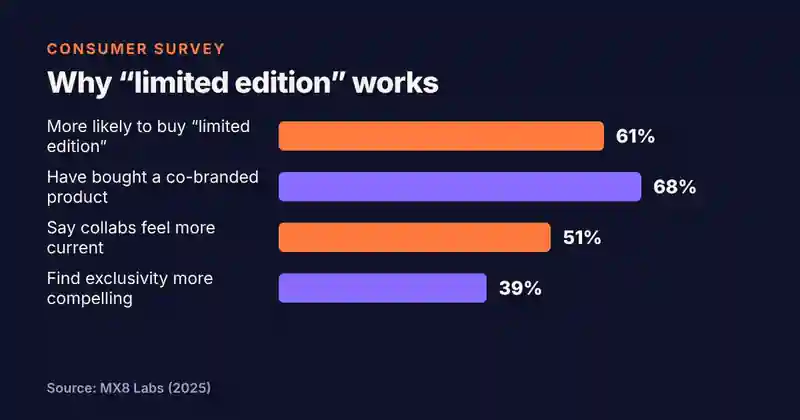
Two things stand out.
First, the consumer-side signal is real. Scarcity labels matter to a meaningful share of shoppers. The classic psychology backs it up too. In a well-known 1975 study by Worchel, Lee and Adewole, people rated identical cookies as more desirable when they came from a jar of two than from a jar of ten.
Second, the proof for conversion lifts is thin. The Obvi countdown result comes from a vendor’s own write-up. OptiMonk itself warns that a countdown can raise clicks and still lower revenue, and recommends measuring revenue (not just clicks) with holdout tests. Good advice. Follow it.
Also note that the MX8 Labs data is about consumer products. B2B buyers are slower and more skeptical. So treat these numbers as a hypothesis for your SaaS, not a promise.
The SaaS version of a “drop”
You don’t need a movie license. You need a reason and a window. Here are five formats that work for software and service businesses.
1. The seasonal release
A themed feature or template pack tied to a real moment: Halloween, Black Friday, end-of-year planning, tax season. The window is built in, and nobody questions why it ends.
2. The cohort launch
“We’re onboarding 25 teams this month.” This only works if it’s true. If you truly have onboarding capacity limits, say so and show the number.
3. The founding-member offer
Early adopters get locked-in pricing or a badge. The scarcity is the time window plus the status.
4. The partner event
A joint webinar, template pack or integration launch with another brand. (This is the “collab” part of the game playbook. We cover it in our guide to brand licensing and borrowing cultural moments.)
5. The retiring asset
A template, report or course that’s available through a set date and then moves behind a paywall. Honest, and easy to explain.
| Format | Best for | Real constraint | Design assets needed |
|---|---|---|---|
| Seasonal release | Product-led SaaS | Calendar | Themed landing page, email header, social set |
| Cohort launch | Service or onboarding-heavy products | Team capacity | Progress/spots-left module, application page |
| Founding-member offer | Early-stage startups | Time or seat limit | Badge, pricing page variant |
| Partner event | Brands with a shared audience | Event date | Co-branded graphics, joint landing page |
| Retiring asset | Content-led teams | Publication window | Cover art, download page |
A 5-step playbook for your first drop
Step 1: Pick a constraint that’s actually true
Capacity, a date, a quantity. If you can’t point to a real reason the offer ends, don’t invent one. Buyers notice countdown timers that reset on every visit, and it costs you trust you’ll never win back.
Step 2: Give it a name and a look
The Dead by Daylight chapters work partly because each has a recognizable identity. Do the same on a smaller scale: a name, a color accent, a hero visual, and a short set of reusable components. Stay inside your brand system so it’s clearly you, just dressed for an occasion.
Step 3: Build the teaser first
Games reveal a first look weeks before launch. Do the same: a one-line teaser on social, an email to your list, a “coming soon” section on your site. People who sign up early are your best conversion audience.
Step 4: Make the deadline visible, not loud
A small, clean date or spots-left indicator beats a flashing banner. Keep it consistent across the landing page, email and ads.
Step 5: Measure revenue, then repeat
Track sign-ups, trial-to-paid and revenue, not just clicks. If you can, hold out a control group that sees the offer without the deadline. Then run a second drop and compare. The goal is a rhythm, not a one-off stunt.
Common mistakes
- Fake scarcity. Resetting timers or “only 3 left” on a digital product with unlimited supply.
- Too many drops. If everything is limited, nothing is. Pick two to four moments a year.
- Off-brand design. A drop that looks like a different company confuses people. Keep your core identity and vary the accent.
- No follow-through. If the deadline passes and you extend it every time, you’ve taught your audience to wait.
What to do this week
- Pick one real moment in the next 60 days (a feature release, a seasonal tie-in, a partner).
- Write the constraint in one sentence.
- List the five assets you need: landing page, email header, social graphic, in-app banner, teaser.
- Get them designed once, with a consistent look, and reuse them across channels.
Need the creative to pull it off?
Limited-edition campaigns live or die on execution speed and visual consistency. You need a themed landing page, social creatives, email headers and maybe a new badge, all within a few days, and all in sync with your brand.
That’s exactly what a design subscription is built for. With Draftss, you can send your drop’s creative requests to a dedicated team of designers, get quick turnarounds, and keep everything on-brand without hiring in-house. Plan your next launch window, and let us handle the visuals.
Drop your thoughts in the comments below.
Your email address will not be published. Required fields are marked *