




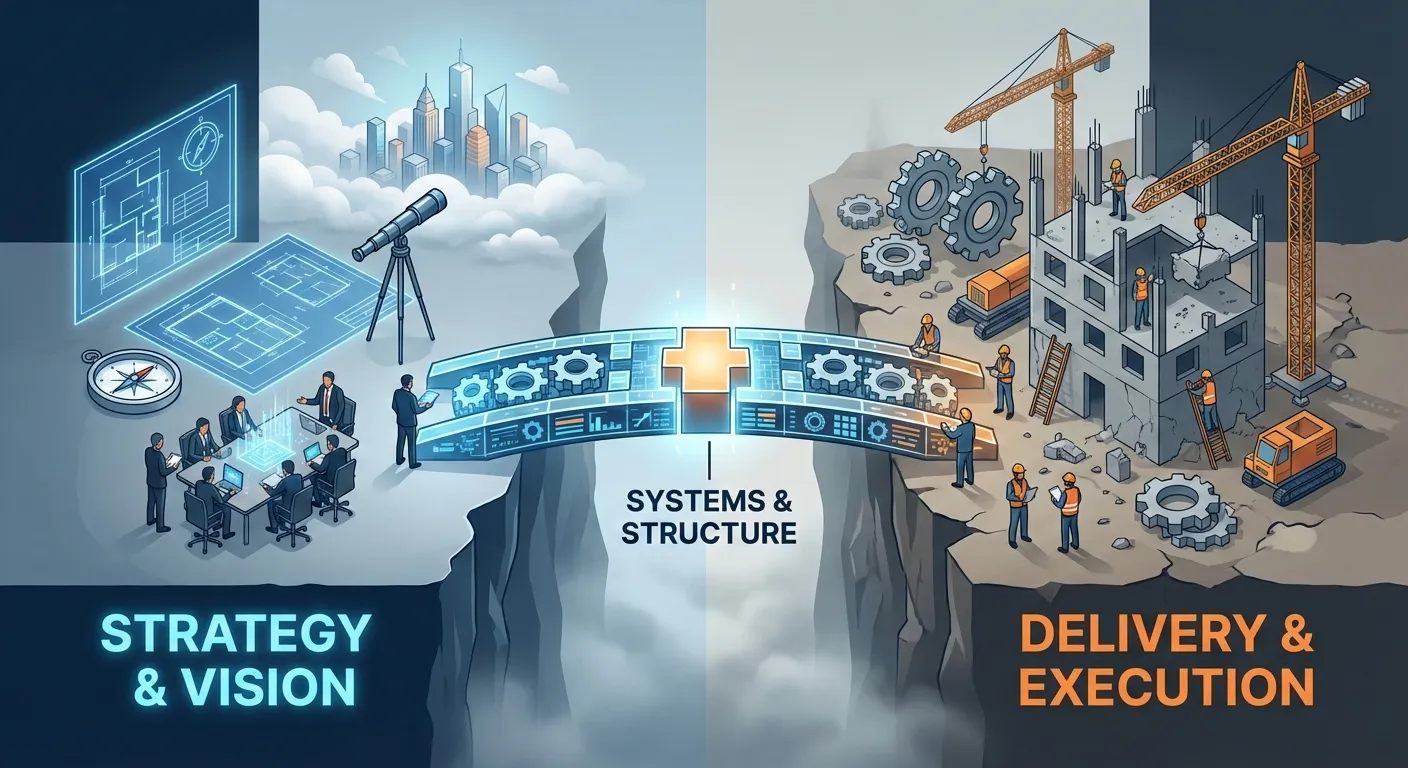
Agencies often invest significant time in strategy, planning, and vision, yet struggle when it comes to execution. This disconnect, commonly referred to as the execution gap, occurs when strategic ambitions fail to translate into consistent, high-quality delivery. Research suggests that nearly 70% of strategic initiatives fail during implementation, not due to poor ideas, but because execution systems are misaligned or absent.
The execution gap emerges when agencies pursue bold strategies without aligning them to operational capacity. Unclear priorities, fragmented communication, and cultures that reward activity over outcomes further widen this gap. External pressures such as shifting client expectations, market volatility, and rapid technological change only compound the problem. Closing this gap requires more than better ideas. It requires systems that support execution at scale.
Table of Contents
- Understanding the Execution Gap
- Defining the Execution Gap
- Statistics on Strategy Implementation
- Reasons for Strategy and Execution Misalignment
- Cultural Barriers in Agencies
- Impact of Environmental Factors
- Real-World Agency Scenarios
- Exploring Execution Systems Over Ideas
- How Execution Systems Improve Results
- Draftss as a Solution for Execution
- Benefits of Using Draftss for Agencies
- Closing the Execution Gap Effectively
- Frequently Asked Questions
Understanding the Execution Gap
The execution gap is a crucial issue that highlights the disconnect between strategy and actual delivery in agencies. It represents the struggle to turn innovative ideas into practical outcomes, causing plans to falter and resources to be wasted. When agencies create ambitious strategies but lack the means to implement them effectively, they face frustration and inefficiency. This gap often stems from poor communication and unclear roles, leaving teams unsure of how to move forward.
By recognizing this gap, agencies can pinpoint weaknesses in their processes, fostering better alignment between objectives and team efforts. Addressing the execution gap is vital, not just for improving operational effectiveness but also for enhancing client satisfaction and achieving business goals. A strong execution strategy, which includes regular check-ins and adjustments based on feedback, can ensure that initiatives remain relevant and actionable.
Ultimately, closing the execution gap demands a commitment to continuous improvement and a willingness to adapt in the ever-changing agency landscape.
Defining the Execution Gap
The execution gap is a crucial concept that highlights the disconnect between the strategies agencies devise and the actual results they achieve. This gap is often the result of various internal and external factors that hinder the delivery of strategic promises. To truly understand the execution gap, one must analyze why many strategies fail to materialize into concrete outcomes. This often stems from poor planning or ineffective execution, where ambitious strategies do not translate into manageable tasks for teams.
Defining the execution gap allows agencies to pinpoint specific areas for improvement, focusing on the challenges of converting high-level strategies into actionable daily tasks. One effective way to measure this gap is by assessing project outcomes against the initial strategic goals. By establishing clear metrics for success, agencies can track their performance and identify execution shortcomings.
A comprehensive definition of the execution gap also includes recognizing the importance of team dynamics and communication in successful execution. When everyone is aligned and working toward the same objectives, the chances of bridging this gap increase significantly. Ultimately, understanding the execution gap empowers agencies to implement targeted strategies that boost performance and enhance client satisfaction.
Statistics on Strategy Implementation
Statistics reveal a stark reality for organizations trying to execute their strategies. A staggering 70% of strategic initiatives fall flat during implementation, highlighting a troubling execution gap. Only 30% of organizations can proudly say their strategies are successfully executed, which underscores the urgent need for improvement. Agencies that prioritize execution stand out in the competitive landscape, being 2.5 times more likely to meet their strategic goals. Yet, a survey found that half of executives believe their organizations falter in effective strategy implementation due to a lack of clarity. Moreover, organizations with clear execution frameworks enjoy 40% better results than those without. Alarmingly, around 80% of companies lack a structured approach to execution, which significantly contributes to this gap. Misalignment among teams can cause a 25% decline in productivity during project execution, and effective communication plays a crucial role in success; 76% of high-performing teams emphasize it. Agencies that consistently review and adjust their strategies based on performance data experience a remarkable 50% increase in successful outcomes. Additionally, employee engagement is a game-changer, with engaged teams achieving 21% higher profitability.
| Statistic | Percentage/Number | Implication |
|---|---|---|
| Strategic initiatives that fail during implementation | 70% | Indicates a significant execution gap in organizations. |
| Organizations reporting successful strategy execution | 30% | Highlights the urgent need for improvement in execution capabilities. |
| Agencies that prioritize execution outperform competitors | 2.5 times | Demonstrates the competitive advantage gained through effective execution. |
| Executives who believe organizations struggle with strategy implementation due to lack of clarity | 50% | Shows that clarity is crucial for alignment in execution. |
| Organizations with clear execution frameworks achieving better results | 40% | Emphasizes the importance of structured execution. |
| Companies without a structured approach to execution | 80% | Illustrates how common the execution gap is in the industry. |
| Loss in productivity due to misalignment between teams | 25% | Underlines the importance of team alignment for execution efficiency. |
| High-performing teams prioritizing effective communication in strategy execution | 76% | Communication is vital for success in execution. |
| Agencies that regularly review and adjust their strategies based on performance data see increased successful outcomes | 50% | Continuous improvement is key to execution success. |
| Engaged teams achieving higher profitability | 21% | Employee engagement directly impacts execution and client satisfaction. |
Reasons for Strategy and Execution Misalignment

Misalignment between strategy and execution is a common issue in agencies, often stemming from unclear strategic goals that fail to translate into actionable tasks. When teams lack a clear understanding of priorities, it can lead to frustration and inefficiency. Additionally, inadequate resource allocation can cripple the execution of strategies, leaving teams scrambling to meet expectations. Poor communication between departments further complicates matters, resulting in teams pulling in different directions and widening the execution gap.
Cultural barriers also play a significant role. In many agency environments, there’s a tendency to reward busy work rather than results, which can distract teams from effective execution. When accountability is lacking, deadlines are missed, and strategic promises go unfulfilled. Rapid market changes can render strategies irrelevant overnight, making it vital for agencies to adapt quickly. However, high-level decisions often overlook the operational realities faced by teams, creating a disconnect that hinders execution. Moreover, setting overly ambitious goals without proper support can overwhelm staff, leading to burnout and disengagement. Lastly, insufficient training and development opportunities prevent team members from acquiring the necessary skills for successful execution. When teams fail to celebrate small wins, it can demotivate them, stalling progress and momentum in executing strategies.
- Misalignment often occurs due to unclear strategic goals that do not translate into actionable tasks for teams.
- Inadequate resource allocation can cause teams to struggle in executing strategies effectively, leading to frustration and inefficiency.
- Poor communication between departments can result in teams working towards different objectives, widening the execution gap.
- Cultural barriers, such as a focus on busy work over results, can hinder effective execution of strategies.
- Lack of accountability among team members often leads to missed deadlines and unfulfilled strategic promises.
- Rapid changes in the market can render strategies irrelevant, making it difficult for agencies to adapt quickly and effectively.
- High-level decisions may not take into account the operational realities faced by teams, creating a disconnect in execution.
- Overly ambitious goals without proper support systems can overwhelm teams, causing burnout and disengagement.
- Limited training and development opportunities prevent team members from acquiring the skills needed for effective execution.
- Failure to celebrate small wins or progress can demotivate teams, leading to a lack of momentum in executing strategies.
Cultural Barriers in Agencies

Agency culture plays a pivotal role in how strategies are executed. Often, these cultures reward effort over results, creating a disconnect between strategic goals and actual team performance. When the focus shifts to planning rather than execution, teams can easily fall into analysis paralysis, stifling their potential for innovation and progress. Resistance to change is another common issue, making it challenging to implement new strategies effectively. Additionally, without an environment that fosters psychological safety, team members may hesitate to voice concerns or suggest improvements related to execution. Cultural silos can further complicate matters, creating barriers between departments that hinder collaboration and the effective execution of cross-functional strategies. If leadership fails to model execution-focused behavior, it sends a clear message that strategy implementation is not a priority. However, celebrating failures as learning opportunities can help shift an agency’s culture towards embracing execution and accountability. Agencies that cultivate transparency and open communication are more likely to succeed in executing strategies effectively. Encouraging team members to take ownership of their roles can enhance their commitment to execution, ultimately driving better results. Aligning culture with strategic goals is essential for fostering an environment that supports effective execution.
Impact of Environmental Factors
Environmental factors play a crucial role in shaping the strategies of agencies and their ability to execute them successfully. Rapid changes in the external market can render established strategies obsolete, pushing agencies to adapt quickly to stay relevant. Economic fluctuations often impact client budgets and priorities, affecting how strategies can be executed. For instance, during an economic downturn, clients may cut back on marketing spend, forcing agencies to rethink their approaches.
Technological advancements also add to this complexity, as tools and methods that worked yesterday may not yield the same results today. Agencies must stay updated on the latest trends and technologies; otherwise, they risk falling behind. Regulatory changes can further complicate matters, requiring agencies to navigate new compliance landscapes while trying to maintain strategic alignment. Competition is another environmental factor that keeps agencies on their toes; the need to frequently reassess strategies in light of competitors’ actions can lead to strategic fatigue.
Moreover, client needs and preferences evolve constantly, necessitating an agile execution approach that can adjust to these shifts. Social trends and changes in consumer behavior can significantly impact the relevance of agency strategies, making it essential for agencies to remain vigilant. Global events, such as pandemics, can disrupt normal operations, forcing agencies to reevaluate their strategies entirely. Understanding these environmental factors empowers agencies to proactively adjust their strategies before execution gaps widen, ensuring they are not just reactive but resilient.
Real-World Agency Scenarios
An agency rolls out a comprehensive marketing strategy for a client, but as priorities shift, the team gets sidetracked by urgent but less important client requests, causing the original strategy to be deprioritized. This leads to mixed results and client dissatisfaction. In another case, a digital agency sets ambitious goals for a product launch but fails to allocate sufficient resources or define clear roles for team members, resulting in missed deadlines and a lack of accountability. Meanwhile, a creative agency comes up with an innovative campaign but neglects to allocate sufficient resources, leading to underwhelming results and missed opportunities for the client. Similarly, an agency identifies a new market opportunity but lacks the execution framework to act, missing the chance entirely. A PR agency creates a comprehensive plan for a client but struggles with internal communication, leading to execution delays and client frustration. In a different scenario, an agency launches a new service without proper training for its team, resulting in inconsistent delivery and client dissatisfaction. A branding agency has a clear strategy but faces resistance from team members who are comfortable with existing processes, hindering implementation. A social media agency sets clear KPIs but fails to monitor progress regularly, resulting in subpar performance. An advertising agency develops a campaign that excites the team, but without a solid execution plan, it fails to deliver results. Lastly, a web development agency has a strategy for a client project but does not account for changing requirements, leading to scope creep and frustration. These scenarios highlight the common pitfalls agencies face, where brilliant strategies often struggle in the execution phase.
Exploring Execution Systems Over Ideas
Execution systems are the backbone of successful agency operations, turning lofty ideas into tangible actions. They provide a structured approach that bridges the often wide gap between strategy and results. To be effective, these systems need clear, actionable steps derived from strategic objectives. When teams have defined tasks, they can focus on what matters most, ensuring that their daily activities align with the overarching goals.
Regular performance evaluations are vital, as they allow teams to adapt their strategies in real-time based on feedback. This adaptability helps keep the agency relevant and responsive in a fast-paced environment. Frameworks like Objectives and Key Results (OKRs) can be powerful tools to prioritize tasks, track progress, and maintain alignment with strategic goals.
Moreover, execution systems create a culture of accountability. When team members understand their specific roles and responsibilities, they are more likely to take ownership of their tasks. This focus on systems, rather than just ideas, leads to streamlined operations and enhanced productivity across the board.
Technology plays a crucial role here; utilizing tools to support execution systems can help agencies capture valuable data and insights. Collaboration tools enhance communication, ensuring that everyone is on the same page regarding execution priorities. Additionally, investing in training and development programs empowers team members to embrace these systems, driving better results.
Ultimately, by prioritizing execution systems, agencies lay the groundwork for sustainable growth and success in achieving their strategic objectives.
How Execution Systems Improve Results
Execution systems are game-changers for agencies, providing a clear roadmap that teams can follow. This clarity reduces confusion and boosts efficiency in project delivery. By defining metrics for success, agencies can track their progress and quickly spot areas needing improvement. Regular check-ins and updates are essential, ensuring teams remain aligned with their strategic objectives and can adapt as necessary. These systems foster accountability, as team members understand their contributions to the overall strategy.
By breaking down larger strategies into manageable tasks, agencies maintain focus and momentum throughout the execution process. Project management tools enhance visibility into project status and potential challenges, allowing for preemptive action. Collaboration flourishes within effective execution systems, paving the way for innovative solutions and stronger team dynamics. Continuous feedback loops enable teams to learn from their experiences, leading to better decision-making in future projects.
Agencies that embrace execution systems often see a boost in client satisfaction, thanks to timely and effective delivery of services. Ultimately, when well-implemented, these systems can significantly improve operational performance and client retention, yielding a noteworthy return on investment.
Draftss as a Solution for Execution
Draftss is a game-changer for agencies looking to boost their execution capabilities. This comprehensive platform offers a structured approach to project management, making it easier for teams to maintain clarity in their execution processes. With the ability to allocate resources flexibly, agencies can quickly adapt to changing project demands and client needs, effectively bridging the execution gap.
Communication and collaboration are streamlined through Draftss, ensuring that every team member is aligned on execution priorities. This is crucial for keeping projects on track and meeting client expectations. The platform also provides valuable templates and frameworks that simplify the creation of actionable plans, allowing agencies to stay focused on their strategic goals.
Performance tracking features enable agencies to measure progress and make necessary adjustments, fostering a culture of accountability by clearly defining roles and responsibilities within teams. With Draftss, agencies can prioritize delivering results without losing sight of their strategic vision or client ownership. The user-friendly interface makes it easy for teams to adopt and integrate into their existing workflows. By leveraging Draftss as their execution infrastructure, agencies can significantly reduce the execution gap, enhancing client satisfaction and driving business growth.
Benefits of Using Draftss for Agencies
Draftss revolutionizes the way agencies manage their projects, making it easier to streamline workflows and hit deadlines without a hitch. Imagine having access to a diverse talent pool right at your fingertips, ensuring that no matter the project, you can always find the perfect designer or developer to match your needs. This flexibility not only enhances creativity but also helps you keep costs in check, as you can minimize reliance on in-house resources and adopt a more project-based hiring approach.
Speed is the name of the game, and with Draftss, you can expect quick turnaround times without compromising quality. In a fast-paced market, this ability to deliver effectively can set you apart from competitors. Enhanced collaboration tools foster teamwork among your members, leading to better project outcomes. Plus, gathering client feedback is a breeze, Draftss allows you to integrate feedback directly into your workflow, making revisions swift and efficient.
As your agency grows, Draftss scales with you, offering the flexibility you need to adjust resource allocation as demands shift. This means you can focus on what you do best: strategizing and building strong client relationships, while Draftss handles the execution behind the scenes as your white-label design and development partner. Quality assurance is another hallmark of the platform, ensuring your deliverables consistently meet or exceed expectations. With data-driven insights at your disposal, you can refine your strategies based on real performance metrics, making informed decisions that align with your agency’s goals.
Closing the Execution Gap Effectively

To effectively close the execution gap, agencies must focus on several key strategies. First, establishing clear communication channels is vital. When everyone understands their roles and responsibilities, misunderstandings fade away, allowing teams to align on common goals. Regular check-ins also play a crucial role. By scheduling frequent progress updates, teams can tackle issues as they arise, fostering accountability and keeping projects on track.
Setting realistic goals is another essential strategy. When objectives are achievable, teams remain focused and motivated, avoiding the burnout that often comes from overwhelming targets. Utilizing project management tools can further streamline workflows, keeping everything organized and reducing chaos.
Investing in training and development is crucial too. A culture of continuous improvement equips teams with the skills they need for effective execution. Encouraging a results-oriented culture shifts the focus from just being busy to achieving tangible outcomes, which can enhance productivity and morale.
Identifying bottlenecks through regular process analysis helps improve workflow efficiency. Empowering teams by granting them decision-making authority fosters a sense of ownership, leading to better execution. Additionally, actively engaging clients throughout the execution process not only meets their needs but also enhances satisfaction.
Lastly, agencies must be ready to adapt to change. Flexibility in strategies based on market feedback can ensure that execution remains relevant and effective, ultimately bridging the gap between strategy and delivery.
Frequently Asked Questions
What is the execution gap in agency work?
The execution gap refers to the difference between the strategies agencies come up with and how well they actually deliver those plans. Agencies may have great ideas, but sometimes the follow-through is lacking.
How can agencies improve their delivery processes?
Agencies can improve delivery by focusing on better communication, setting clear expectations, and ensuring that the team is aligned with the overall strategy. Regular check-ins and feedback loops can also help.
Why do agencies struggle with implementation?
Agencies often struggle with implementation due to miscommunication, lack of resources, or unrealistic timelines. Sometimes, the creative ideas are not matched with the available tools or skills needed to execute them.
What role does project management play in closing the execution gap?
Project management is crucial in closing the execution gap. Strong project management helps keep everyone on track, organizes tasks, and ensures that deadlines are met, all of which contribute to successful delivery.
Can technology help in bridging the execution gap?
Absolutely! Technology can streamline processes, improve communication, and provide tools for tracking progress. By utilizing the right tech, agencies can enhance their delivery and align it more closely with their strategies.
TL;DR The execution gap highlights the disconnect between strategic goals and practical implementation in agencies. Despite 70% of strategies failing during execution, common issues like misalignment, cultural barriers, and environmental factors contribute to this challenge. Real-world scenarios demonstrate the consequences of neglecting execution systems. By prioritizing execution frameworks, agencies can close the gap and enhance effectiveness. Draftss offers an execution infrastructure that streamlines processes, ensures flexibility, and emphasizes delivery to help agencies fulfill their strategic visions while maintaining client satisfaction.
Drop your thoughts in the comments below.
Your email address will not be published. Required fields are marked *