




Imagine waking up to a video of your founder promising “guaranteed returns” to your customers. It looks real. It sounds real. It’s your logo in the corner.
And you never made it.
This isn’t science fiction. It’s the fastest-growing fraud category on the internet, and startups with recognizable faces and logos are prime targets.
Here’s the good news: you can make your brand much harder to fake and much faster to defend. In this guide, I’ll show you 7 practical ways to protect your visual identity, with a checklist you can use this week.
How big is the deepfake problem, really?
Let’s start with the numbers, because they’re hard to ignore.
A Surfshark analysis of the AI Incident Database, Resemble.AI and OECD data, published in July 2026, found:
- $3.7 billion in recorded deepfake fraud losses between January 2020 and June 2026.
- $2.5 billion of that happened in 2025 alone, up from $335 million in 2024.
- $764 million was lost in just the first half of 2026.
- $1.73 billion (47%) started on social media.
- $911 million (25%) came from impersonation and identity fraud.
The researchers call these figures conservative because they only count publicly reported cases. Real losses are almost certainly higher.
The study also breaks losses down by channel:
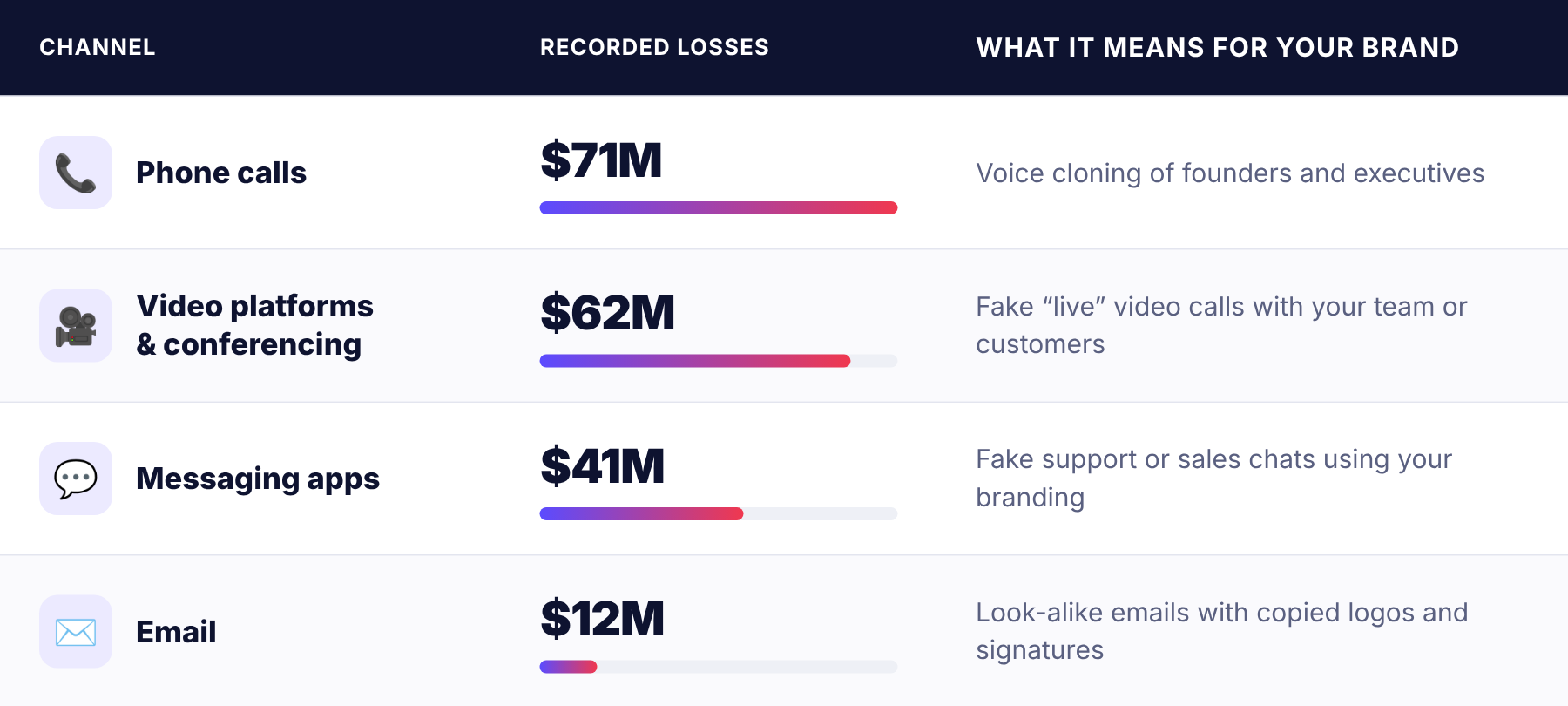
Source: Surfshark Research, July 2026.
Notice a pattern? Every one of these attacks leans on something visual or audible that makes you look legitimate. That’s exactly what your brand identity is.
Why a strong visual identity is your first line of defense
You can’t stop people from copying pixels. But you can make a fake easier to spot, and a real communication easier to verify.
Think of it like a signature. A messy, inconsistent signature is easy to forge. A distinctive, consistent one is much harder to fake and much easier for your bank to question.
Brands work the same way. When your logo, colors, typography, layouts and tone follow cohesive branding rules, customers and employees develop a “feel” for what’s real. Anything off triggers suspicion.
7 ways to protect your visual identity from deepfakes
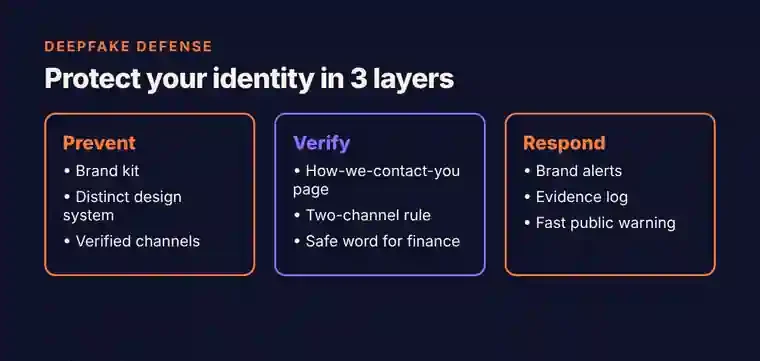
Here’s the whole framework at a glance. The seven tactics below fall into three layers: prevent the fake, verify what’s real, and respond fast when something slips through.
1. Build (and publish) a real brand kit
If your assets live in random folders and old Slack threads, you’ve already lost control. Create a single source of truth for your brand visual identity that includes:
- Primary and secondary responsive logo files (SVG and PNG)
- Exact color codes (HEX, RGB, CMYK)
- Approved fonts and sizes
- Email signature and social templates
- Photography and illustration style rules
- Do’s and don’ts for logo use
Then make a public version. A simple brand page on your site tells partners and press what “real” looks like, and gives customers something to compare against.
2. Make your design system distinctive
Generic brands are easy to clone. Distinctive ones aren’t. A custom icon style, a signature color pairing or a recognizable layout pattern gives you “tells” that fakes rarely get exactly right.
Don’t overdo it. One or two memorable, consistent elements used everywhere beat ten random flourishes.
3. Verify every official channel
Claim your handle on every major platform, including ones you don’t plan to use. Get verified where possible. Then link to all official channels from your website footer and email signature.
Since social media is the origin of 47% of recorded deepfake losses, this step matters more than most founders realize. For the bigger picture on trust, see what the Pokimane deepfake backlash teaches startups.
4. Create a “how we contact you” page
Tell customers exactly how you will and won’t reach them. For example:
- “We will never ask for payment details over DM.”
- “Our support emails only come from @yourdomain.com.”
- “We never run giveaways that require sending money first.”
Link it from your footer, onboarding emails and support docs. It takes an hour to write and can save you from a nightmare.
5. Set a verification rule for your team
Impersonation fraud is already a $911 million problem. Your team is a target too. Set a simple rule: any request involving money, credentials or sensitive data must be confirmed through a second, pre-agreed channel.
This works even when the voice or face on the call looks exactly like your CEO. Consider a shared “safe word” for finance and ops teams.
6. Be intentional about founder and team imagery
Fakes need source material. The more high-resolution video and voice samples of your leadership are public, the easier cloning becomes.
You don’t have to hide. Instead, keep a catalog of your official videos and photos on your own site, and watermark or add consistent on-brand framing (lower-thirds, intro cards, end cards) to your video content. It won’t stop a determined attacker, but it gives your audience a way to tell what’s genuinely yours.
7. Monitor and respond fast
Set up alerts for your brand name, founder names and product names. Run reverse image searches on your logo every month. When you find a fake:
- Screenshot and save evidence with URLs and timestamps.
- Report it to the platform using its impersonation or fraud form.
- Post a short, calm warning on your official channels.
- Email affected customers if the fake targeted them directly.
Speed matters. A warning posted within hours is far more effective than a perfect statement posted a week later.
Your deepfake-readiness checklist
| Task | Time | Done? |
|---|---|---|
| Gather all brand assets into one shared folder | 10 min | ☐ |
| Claim handles on the top 5 platforms | 10 min | ☐ |
| Draft your “how we contact you” page | 10 min | ☐ |
| Agree on a two-channel verification rule | 5 min | ☐ |
| Set brand-name alerts | 5 min | ☐ |
That adds up to about 40 minutes. Still worth it.
What not to do
- Don’t panic-buy detection tools. Detection is an arms race. Prevention and verification habits work better for most startups.
- Don’t ignore small fakes. A fake giveaway account with 200 followers can still scam your best customers.
- Don’t use synthetic faces for testimonials. It hurts trust and makes real fakes harder to spot.
On that last point, consumer sentiment backs it up. In a Clutch survey (August 2026, 601 consumers), 64% said they’d trust a brand or creator less if AI-generated content misrepresented its products. For a full framework, read our guide to using AI without losing audience trust.
The bottom line
Deepfakes are growing faster than most brands can react. But you don’t need an enterprise security budget to protect yourself.
You need a consistent identity, verified channels, clear communication rules and a team that knows what to do. Do those four things and you’re ahead of most of your competitors.
Ready to build a brand identity that’s distinctive and easy to defend? Draftss gives you unlimited design requests for a flat monthly fee. That covers brand kits, logos, social templates and more, delivered fast by a dedicated design team. Get started with Draftss today.
Drop your thoughts in the comments below.
Your email address will not be published. Required fields are marked *