

Airtable
See pricing for Airtable, the no-code app and database platform for teams, from the Free plan to the Team, Business and Enterprise Scale plans.
Airtable Pricing Page Design
$0 - $49 4 Plans
Launch Website
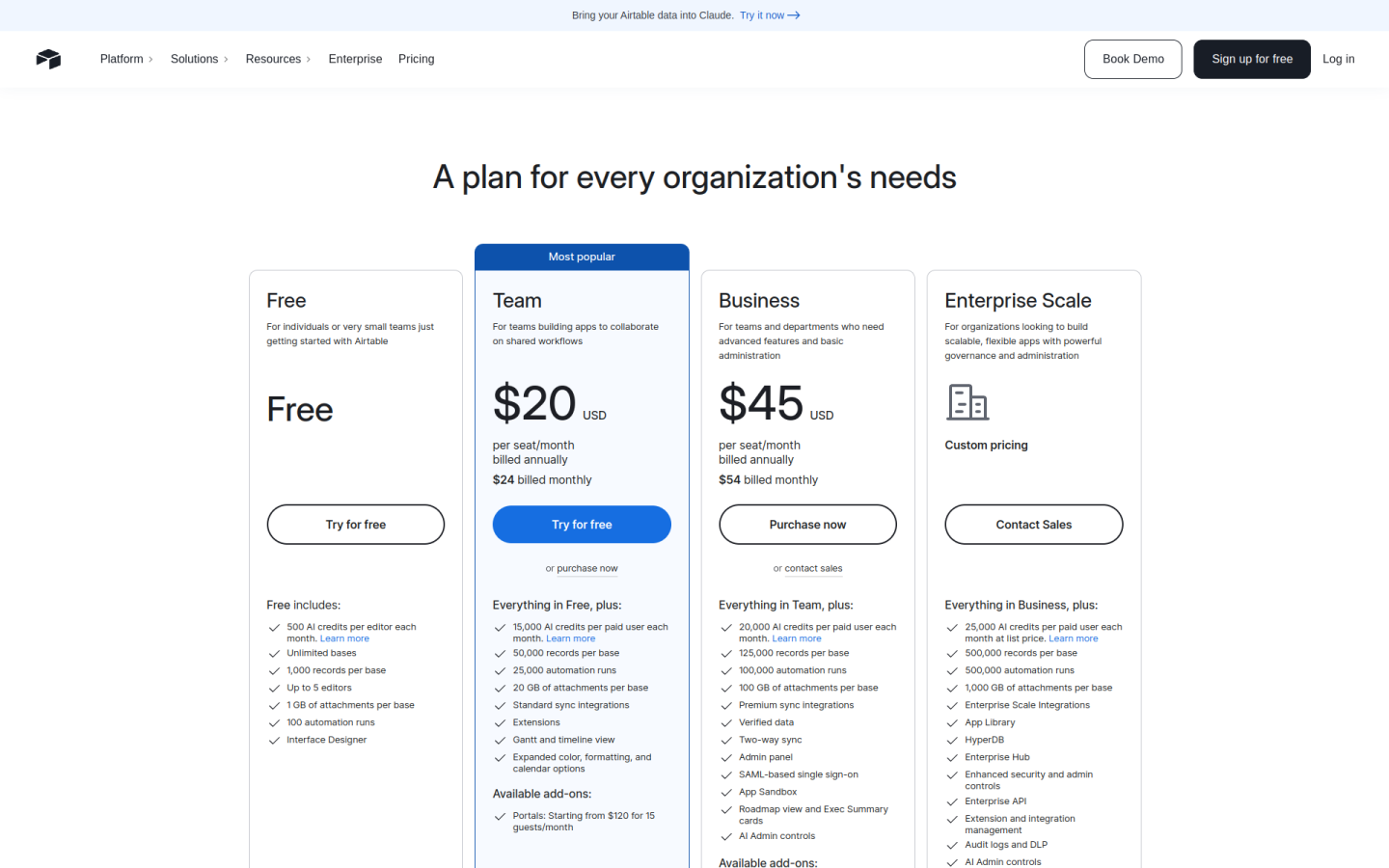
The Airtable pricing page is built to move teams from a free database to a scalable app platform for the whole company:
1. Clear Hierarchy and Visual Appeal:
- Simple Headline: The page opens with “A plan for every organization’s needs,” which tells visitors right away that the plans grow with the size of the company.
- Four Plans in a Row: Free, Team, Business and Enterprise Scale sit side by side, moving from individuals and small teams to large organizations.
- Clear Calls to Action: “Sign up for free” sits on the self-serve plans, while “Book demo” and “Contact Sales” mark the sales-led options.
- Legacy Plan Kept Separate: A Legacy Enterprise plan is listed for existing customers only, with a note that nothing changes until renewal.
2. Value-Based Differentiation:
- Free: Aimed at “individual users, very small teams, or those with lightweight needs,” with up to 5 editors per workspace and the basic Interface Designer.
- Team: Adds the capacity growing teams need, with Gantt and Timeline views, extensions and much higher record and automation limits.
- Business: Adds customization, data scale and admin features for departments, including an admin panel, two-way sync and SAML-based SSO.
- Enterprise Scale: Offers unlimited org units, workspaces and bases, plus enterprise controls such as audit logs and data loss prevention.
3. Transparent Pricing:
- Annual Prices: Team costs $20 per user per month and Business costs $45 per user per month when billed annually.
- Monthly Prices: On month-to-month billing, Team is $24 and Business is $54 per user per month, so annual billing saves about 17%.
- Custom Enterprise Pricing: Enterprise Scale is priced to each organization’s needs and scale, and buyers need to contact sales for a quote.
- Fair Seat Billing: Only users with edit access to at least one base are billed, while read-only collaborators, form submissions and share links are free.
4. Addressing Different User Needs:
- Individuals and Small Teams: The Free plan lets people start building bases at no cost before they commit to a paid plan.
- Growing Teams: Team can be paid by credit card, so small groups can upgrade without talking to sales.
- Larger Companies: Business and Enterprise Scale can be bought through sales and paid by annual invoice, PO, ACH, wire or check.
- Special Groups: The page links to dedicated plans for nonprofits and education customers.
5. Strategic Use of Limitations and Social Proof:
- Usage Limits: Each plan caps records, attachments, automation runs and AI credits, rising from 1,000 records per base on Free to 50,000 on Team and 125,000 on Business.
- Gentle Upgrade Path: The FAQ explains that hitting a record or attachment limit never blocks access or removes data, but new records cannot be added until the plan is upgraded.
- Prorated Charges: Users added in the middle of a billing cycle are charged on a prorated basis, which makes it easy to grow a team over time.
- Customer Story: The headline “More money, fewer problems” shares how Code and Theory consolidated its tools and saved more than 10,000 hours with Airtable.