

Workfront
The Workfront pricing section is effective for several reasons: 1.
Workfront Pricing Page Design
3 Plans
Launch Website
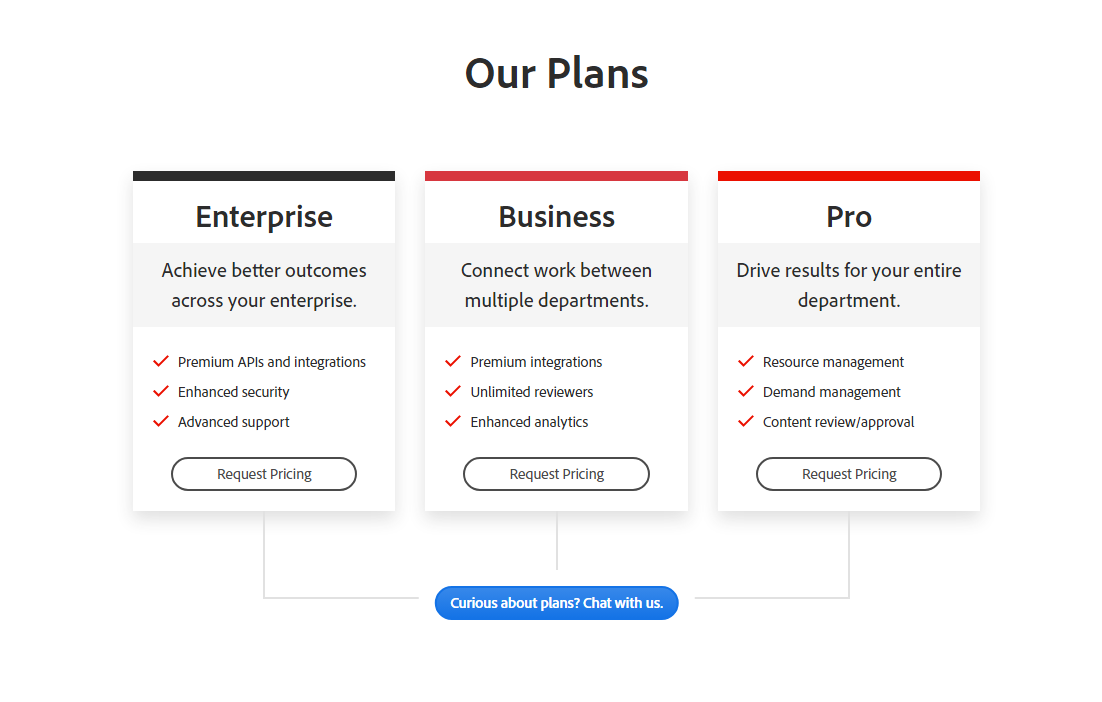
The Workfront pricing section is effective for several reasons:
1. Clear Hierarchy and Visual Appeal:
- Headline Focus: “Our Plans” clearly states the purpose of the section.
- Tiered Structure: “Enterprise,” “Business,” and “Pro” offer a simple, three-tiered choice.
- Concise Descriptions: Each tier has a brief, descriptive label explaining its target audience.
- Visual Distinction: Color-coded headers (black, dark red, bright red) differentiate the tiers.
- Clear Call to Action: “Request Pricing” buttons are prominent for each tier.
- Chat Option: “Curious about plans? Chat with us.” provides an alternative engagement method.
2. Value-Based Differentiation:
- Benefit-Oriented Language: Descriptions focus on what the user gains (e.g., “Achieve better outcomes,” “Connect work,” “Drive results”).
- Feature Comparison: Checkmarks clearly indicate included features in each tier.
- Targeted Messaging: Each tier is tailored to specific needs:
- Enterprise: Large organizations needing advanced features and support.
- Business: Focuses on cross-departmental collaboration.
- Pro: Targets individual departments with essential tools.
3. Transparent Pricing:
- “Request Pricing” Only: No actual prices are listed. This is a common practice for enterprise-focused SaaS, but it sacrifices immediate transparency for lead generation and personalized quotes.
4. Addressing Different User Needs:
- Large Organizations: “Enterprise” caters to complex needs with advanced features and support.
- Collaborative Teams: “Business” targets organizations needing cross-departmental workflows.
- Individual Departments: “Pro” focuses on departmental needs with a core set of features.
5. Strategic Use of Information:
- Feature Highlights: Each tier lists a few key features to entice users.
- Limited Information: The information is intentionally concise, pushing users to engage with sales.